
Severe Bleeding First Aid
How to Use a Tourniquet in an Emergency
You may never need to use one—but if a major limb bleed will not stop with firm pressure, knowing what to do next can buy precious time until paramedics arrive.
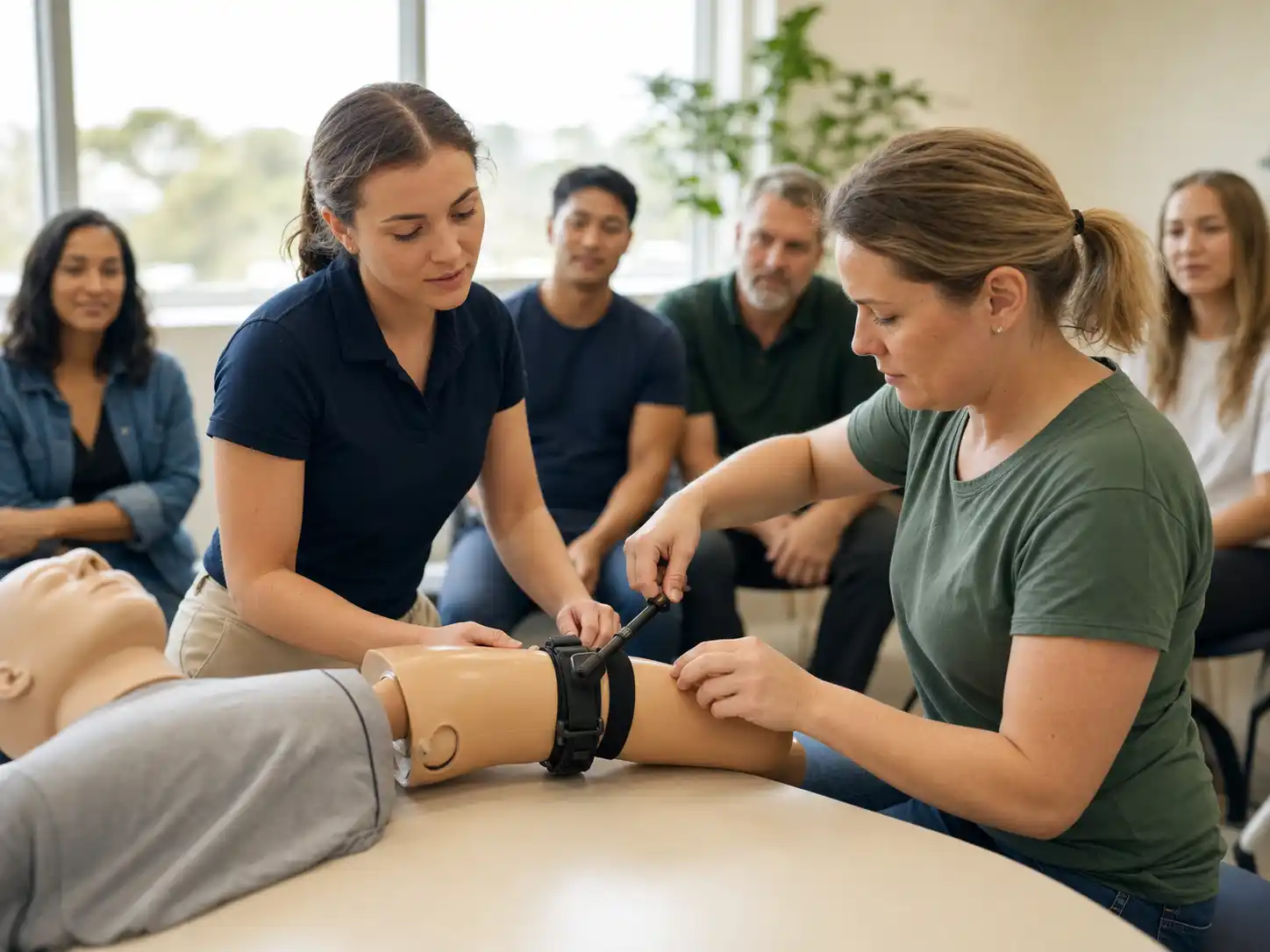
Table of Contents
Quick Answer
Apply firm direct pressure first and call Triple Zero (000). If life-threatening bleeding from an arm or leg is not controlled by pressure, use a commercially manufactured arterial tourniquet if you are trained and one is available. Follow its instructions, or place it about 5 cm above the bleeding point if no positioning instruction is available. Tighten until bleeding stops, record the time, keep it visible and do not remove it.
If this is happening now
- Make sure it is safe to help. Use gloves and eye protection if readily available.
- Lie the person down and apply firm pressure directly on or around the wound.
- Call Triple Zero (000) for an ambulance. Put the phone on speaker if you are alone.
- If uncontrolled, life-threatening bleeding is from a limb, apply an arterial tourniquet if trained.
- Keep monitoring response and breathing. If the person becomes unresponsive and is not breathing normally, follow DRSABCD.
Recognise Life-Threatening Bleeding
Most external bleeding is controlled with firm pressure. A tourniquet is reserved for a much more serious situation: blood loss that threatens life and comes from an arm or leg.
ANZCOR Guideline 9.1.1 says bleeding should be managed as severe and life-threatening when there is an amputation or partial amputation above the wrist or ankle, a shark attack or similar major trauma, bleeding that is not controlled by local pressure, or bleeding accompanied by signs of shock.
- Blood is flowing rapidly, pooling or repeatedly soaking through what you press against the wound.
- A limb has been amputated or partly amputated.
- There is major machinery, propeller, vehicle, farm, workplace or marine trauma.
- The person is becoming pale, sweaty, confused, drowsy or less responsive.
Do not wait for every sign. In a catastrophic bleed, controlling the bleeding takes priority over airway and breathing interventions. Rapid ambulance transfer remains essential because a tourniquet only buys time; it does not repair the injury.
Pressure, Tourniquet or Haemostatic Dressing?
1. Direct pressure
Start here for all external bleeding. Press firmly on or around the bleeding point and maintain pressure.
2. Tourniquet
Use for uncontrolled, life-threatening bleeding from an arm or leg when trained and one is available.
3. Haemostatic dressing
Consider for a site unsuitable for a tourniquet, when no tourniquet is available, or when a correctly applied tourniquet has not stopped the bleeding.
For a detailed explanation of the third option, read our companion guide to haemostatic dressings.

How to Use a Tourniquet
Commercial tourniquets use different buckles, straps and tightening mechanisms, so get to know the model in your kit before you ever need it. The steps below bring together the core ANZCOR principles for a trained first aider; always follow the instructions supplied with your device.
- Expose and identify the bleeding point. Remove or cut clothing if necessary, but do not delay control of obvious catastrophic bleeding.
- Position the tourniquet above the wound. Follow the manufacturer’s placement instructions. If none are available, position it about 5 cm above the bleeding point. Do not place it directly over the wound or a joint.
- Pull the strap firmly and remove slack. A loose first wrap makes the tightening mechanism less effective.
- Tighten until bleeding stops. Effective arterial compression is usually painful. Do not stop merely because the person reports pain.
- Secure the tightening mechanism. Lock the windlass or other device exactly as its instructions require.
- Recheck the wound. Look for continued bleeding. The goal is complete control, not simply slower blood loss.
- Record the time. Write it on the device if it has a time tab, or note it clearly and tell paramedics.
- Leave it visible and in place. Do not cover it with clothing or bandages and do not loosen or remove it.


If the Bleeding Does Not Stop
Continued bleeding means the first tourniquet is not yet effective. Check whether it is above the wound, away from a joint, lying flat and tight enough. Tighten it further if the device permits.
If bleeding continues and a second tourniquet is available, ANZCOR advises applying it to the same limb, preferably above the first. A trained first aider may also consider a haemostatic dressing with the tourniquet when a correctly applied tourniquet has not controlled the bleeding.
Commercial, Improvised and Venous Tourniquets
Commercial arterial tourniquets
Purpose-built arterial tourniquets use a mechanical system—commonly a windlass—to create and maintain enough pressure to stop arterial blood flow. ANZCOR reports that commercially manufactured windlass devices are more effective than improvised tourniquets, particularly when the first aider has practised their use.
Improvised tourniquets
Improvised devices are less reliable. If they fail to stop all circulation they can increase bleeding while also damaging tissue. In otherwise uncontrolled life-threatening limb bleeding, however, ANZCOR states that a broad improvised tourniquet tightened with a rod or stick may be better than no tourniquet. This is an emergency fallback, not a reason to choose a belt or cord over a proper device.
Venous tourniquets
The elastic band used for a blood test or intravenous cannula is designed to make veins easier to access. It is not an arterial tourniquet and cannot be substituted for one during catastrophic bleeding.
Tourniquets for Children
The 2025 International Consensus on First Aid Science supports manufactured windlass tourniquets for life-threatening extremity bleeding in children, although the certainty of evidence is very low.
Fit matters. On an infant or small child, the limb may be too small for a particular device to become snug before the tightening mechanism is activated. ILCOR recommends direct manual pressure, with or without haemostatic trauma dressing, when a tourniquet cannot fit snugly. This is another reason to learn the equipment you carry rather than assuming every device fits every casualty.
Tourniquet Mistakes to Avoid
- Using one for a minor wound or bleeding controlled by pressure.
- Placing it below the bleeding point, over the wound or across a joint.
- Leaving slack in the strap or stopping before bleeding has ceased.
- Covering it, which makes reassessment and paramedic handover harder.
- Loosening it periodically or removing it before specialist care.
- Assuming a narrow cord, shoelace or venous blood-draw band is equivalent to a commercial arterial device.
- Delaying Triple Zero (000) or hospital transfer because the bleeding appears controlled.
After a Tourniquet Is Applied
Keep the person lying down, still and warm. Reassure them, continue to check response and breathing, and watch for the bleeding to restart. Tell the Triple Zero call-taker and responding paramedics that a tourniquet has been applied, where it is and the application time.
Do not promise that the device can safely stay on for a particular number of hours. The correct first-aid message is simpler: uncontrolled bleeding is immediately life-threatening, the tourniquet should remain in place, and the person needs urgent specialist care.
A tourniquet is also not the treatment for an Australian snake bite. Use the pressure immobilisation technique, keep the person still and call Triple Zero (000).
Tourniquet FAQs
When should a first aider use a tourniquet?
How tight should a tourniquet be?
Where should a tourniquet be placed?
Should you remove or loosen a tourniquet?
Can a belt be used as a tourniquet?
Do you use a tourniquet for a snake bite?
Learn Severe-Bleeding Control Hands-On
Reading the sequence helps, but correct tourniquet use depends on recognising catastrophic bleeding, removing strap slack and tightening decisively. These are practical skills.
Our HLTAID014 Provide Advanced First Aid course includes practical emergency scenarios and advanced first aid equipment. Training gives you the chance to apply a device, check whether it worked and correct mistakes in a safe setting.
Authoritative sources
Onsite Workplace
Group Bookings

Nationally recognised certificates
10 years of professional training
Sessions tailored for your group

Public
Bookings
Nationally recognised certificates

10 years of professional training
8 locations Brisbane-wide


